Author Archives: bookerstallworth

Senate Republicans demand special session to address gas prices

Citing the extreme financial pain being felt at the pump, State Sen. Judy Warnick, R-Moses Lake, is leading a formal legislative push for the governor to convene a special session of the Legislature to address Washington’s unaffordable fuel prices.

“We cannot afford to wait until the next regular legislative session while our families choose between putting food on the table or putting gas in their tanks,” warned Warnick, who serves as the chair of the Washington State Senate Republican Caucus. “The time for leadership is now. Our state’s own policies have artificially inflated prices, leaving Washingtonians paying some of the highest fuel costs in the nation. We are demanding a special session to deliver immediate economic relief.”

In a letter sent to the governor today, which follows up on earlier efforts by Warnick and her colleagues to encourage action from Gov. Bob Ferguson, Senate Republicans call for legislative intervention to undo the harm caused by state policies like the carbon pricing program and escalating baseline taxes. While national gas prices trend downward, Washington drivers continue to face a steep premium due to compounding state regulations.

Warnick noted that the executive branch has missed opportunities to deliver this relief much sooner, but acting now is critical to prevent further damage.

“The governor may be frustrated by hearing repeatedly from Republicans about the need for relief at the pump, but that is nothing compared to the frustrations felt by Washingtonians who see others across the country paying nearly $1.25 less per gallon,” explained Warnick.

She also argues that this financial burden falls disproportionately on rural communities and the agricultural sector. Unlike urban areas, rural residents lack access to public transit options and have no choice but to pay exorbitant prices for essential daily travel.

“These are the people I know best,” said Warnick. “They are feeling real pain and deserve much better from their government.”

Warnick calls on Ferguson to provide relief as fuel taxes set to rise July 1

State Sen. Judy Warnick, R-Moses Lake, today said it is urgent for Gov. Bob Ferguson and the legislative Democrat majority to take action that drops Washington’s inflated gas and diesel prices closer to the national average.

Warnick, chair of Washington’s Senate Republicans, issued her call for relief today, seven days ahead of the July 1 automatic 2% gas-tax increase.

This newly enacted indexing mechanism permanently ties fuel fees to inflation, guaranteeing annual hikes. The state-level increase comes as federal efforts to free transit through the Straits of Hormuz are resulting in lower global crude costs and falling national gas prices, leaving Washington drivers locked out of that relief.

Compounding the issue, the Washington Department of Ecology announced Tuesday that Director Casey Sixkiller and Governor Ferguson intend to sign an agreement on June 25 to link Washington’s carbon market with those of California and Québec. This will create a bureaucratic integration process that officials admit will do nothing to provide immediate much-needed relief.

“While the rest of the country looks forward to relief at the pump as global supply chains reopen, Washingtonians are being left behind because the state’s Democrat leaders are standing in the way,” Warnick said. “This complex, out-of-state linkage deal won’t even see the light of day this year. The governor has the executive tools right now to provide immediate relief to our citizens, which include suspending policies that have artificially inflated Washington fuel prices. We need him to use them. Moving forward without providing this relief directly adds to the financial burden being forced onto working families.”

As a long-time champion for Central Washington, Warnick emphasized that these compounding energy policies hit rural families and the agricultural sector hardest. Farmers face evaporating margins due to steep fuel costs for machinery and transport. Meanwhile, rural residents without public transit face an unfair additional financial burden, paying for basic travel. These state-driven fuel costs ultimately spike grocery prices, worsening the food affordability crisis for all Washingtonians and placing local producers at a global competitive disadvantage.

According to AAA, Washington drivers face some of the highest fuel costs in the nation, averaging $5.30 per gallon for regular unleaded. That is $1.37 above the national average of $3.93 per gallon. Warnick points out that this steep premium is driven directly by state policies, including a compounding baseline gas tax rising to 56.5 cents on July 1, the Climate Commitment Act’s carbon pricing program (estimated to add 52 to 56 cents/gallon), and a costlier fuel-formulation standard aimed at reducing emissions.

Warnick emphasized that this crisis is entirely policy-driven, and the executive branch has clear options to provide immediate financial relief.

“We do not have to watch our agricultural economy and rural communities take this hit,” Warnick said. “The governor should step in and ease this pain, and show the leadership our state needs right now.”

According to Warnick, rather than letting these burdens compound, Ferguson could immediately choose to utilize his emergency authority to suspend the Climate Commitment Act’s carbon program and the state’s Low Carbon Fuel Standard compliance premiums.

He could also work with lawmakers to permanently dismantle the automatic 2% annual inflation-indexing mechanism.

She highlighted that New York, under the leadership of a Democrat governor and Democrat-controlled legislature, has recently opted to pull back from its own carbon scheme because of increased costs at the pump for New Yorkers.

“Washingtonians need and deserve the same relief,” said Warnick. “Governor Ferguson and his allies in the Democrat-controlled legislature must address the reality of the affordability crisis in rural Washington.

“When Washingtonians are paying some of the highest gas prices in the country, it isn’t an accident; it’s a choice made by Olympia. It is time for Governor Ferguson to act and give our farmers, ranchers, and rural families the breathing room they desperately need.”

Statement from Senator Judy Warnick on the grand opening of Twelve’s AirPlant One in Moses Lake

Sen. Judy Warnick, R-Moses Lake, released the following statement today regarding the grand opening of Twelve’s new commercial-scale sustainable aviation fuel facility, AirPlant One:

“This is a monumental day not just for Moses Lake but also for the future of sustainable technology across the nation. I am absolutely thrilled to welcome Twelve to our community and to celebrate the opening of AirPlant One.

“For years, I have championed legislative incentives to foster innovation and bring high-quality, forward-thinking jobs to central Washington. Seeing those efforts culminate in a world-class facility that transforms captured carbon and renewable electricity into aviation fuel is incredibly rewarding.

“Moses Lake has a proud history of supporting aviation and industry, and today we firmly establish ourselves at the center of the next generation of aerospace manufacturing. This project proves that environmental innovation and rural economic growth can go hand in hand. I congratulate Twelve, their partners, and our local workforce for making this groundbreaking achievement a reality right here in our backyard.”

As a long-term supporter of the industry, Warnick co-sponsored Engrossed Substitute Senate Bill 5447, which passed into law in 2023 and established a preferential state business and occupation (B&O) tax rate of 0.275% and a per-gallon tax credit of up to $2 for alternative jet fuels. To build on this foundation and provide early-stage capital certainty for pioneering companies like Twelve, earlier this year she also introduced Senate Bill 5932, aimed at ensuring these vital tax incentives are locked in for a full decade as local facilities scale up their production.

Local voices, not courts, should lead the way on WA redistricting

A messy redistricting battle is breaking out all across the country. In states like Mississippi, Virginia and Missouri, political maps are trapped in an endless loop of court fights and mid-cycle changes. Political parties are treating voting boundaries like a game of tug-of-war. They adjust the lines constantly to guarantee a specific political outcome, leaving voters feeling disconnected and ignored.

For decades, Washington state avoided this kind of chaos. Our state Constitution includes a clear promise. It says our legislative lines should be drawn through a transparent, bipartisan process.

The people created our bipartisan Redistricting Commission for a specific reason. They wanted to protect our state from hyperpartisan map-rigging. This process keeps communities of interest together. It ensures that neighbors who share schools, local economies, and cultural heritages have a unified voice in Olympia. Unlike the courtroom, where maps are decided behind closed doors, the commission is built on direct community engagement, holding public forums and taking local testimony to ensure the residents themselves shape their boundaries.

Unfortunately, Washington has now joined the national chaos. A series of federal court decisions bypassed our state commission, with a Clinton-appointed federal judge completely rewriting the legislative boundaries for Central Washington. He made one district look like an octopus crawling along the Columbia River. He altered 13 total districts throughout the state, giving Democrats additional power in 12 of them.

This local issue has now reached a boiling point on the national stage. In late April, the U.S. Supreme Court ruled on a major redistricting case out of Louisiana. That ruling placed strict limits on using race as the main factor to override local community lines.

Based on that decision, local Hispanic challengers asked a federal court to throw out Washington’s redrawn map. The court denied that request on May 15. Now, an emergency appeal seeking to overturn that specific denial has been fast-tracked directly to the U.S. Supreme Court and remains active. But while judges and outside activists argue over legal theories, local families are the ones facing the real consequences.

This top-down map-making has been incredibly disruptive for the Hispanic community in our region. Critics from Seattle or Washington, D.C., often claim these new court maps give Latino voters a stronger voice. The reality on the ground is very different. The Hispanic community in Central Washington is not a single, identical voting bloc. You cannot just slice it up on a grid. Our Latino community is made up of small business owners, farmworkers, church leaders and families. They are deeply woven into the local fabric of this region.

When a court arbitrarily shifts boundaries, it breaks apart long-standing community partnerships. Cohesive neighborhoods are split right down the middle. In many cases, these new lines removed locally chosen legislative advocates. These were leaders who truly understood the unique water, agricultural, small business and infrastructure needs of the Yakima Valley. The court-ordered split makes it much harder for local Hispanic leaders to work together on vital regional priorities.

Rather than empowering Hispanics, the court-ordered maps actually decreased the Hispanic population in Central Washington’s majority-minority district and redistricted out the only Latina senator in eastern Washington.

We must return to stability and local choice. Washington’s bipartisan commission model is still the best way to get fair representation. It requires actual compromise, transparency and public input from local residents. When federal courts step in and allow partisan gamesmanship to dictate redistricting maps instead of listening to the community, local voices get drowned out.

The ongoing fight before the nation’s highest court proves an important point. True representation cannot be forced on a community by a federal judge or partisan elites in Seattle. It has to grow from the ground up. It must respect the actual, living boundaries of the people in central Washington.

No matter how the Supreme Court rules in the coming months, the state Legislature needs to act. We must strengthen our redistricting laws. We need to protect local communities from outside disruption. The diverse voices of the Yakima Valley deserve to be heard because of their value to our state, not because they fit into a box on a court-ordered map.

It is time to return the power of self-governance to the people who actually live here.

Read Online:


As summer heat looms, Warnick pushes for wildfire insurance transparency and central Washington water security

With the start of summer at hand, state Sen. Judy Warnick, R-Moses Lake, is encouraging state leaders to address seasonal water insecurity and the lack of transparency surrounding how rural wildfire insurance is rated.

As central Washington communities brace for the hot, dry months ahead, they face heavy demands on regional water supplies and the annual threat of wildfire smoke. Warnick is calling for a common-sense approach to rural resilience and consumer rights.

“Folks out here just want a fair shake and a clear answer,” said Warnick. “If a family is doing the hard, expensive work of clearing brush, creating defensible space, and keeping their property safe from fire, they have every right to know exactly how their insurance company is sizing them up. We need a system where homeowners can actually see their risk scores, understand the math behind them, and get the credit they deserve for protecting their property.”

To help families get those answers, Warnick prime-sponsored Senate Bill 5928. This consumer-protection measure was designed to pull back the curtain on how rural properties are evaluated for wildfire risk. The legislation would require insurance companies to provide clear, plain-language explanations of the data they use. It would also give homeowners a straightforward way to appeal inaccurate scores.

While the bill passed the Senate with an overwhelming 48-1 bipartisan majority, it ultimately stalled in the House during this year’s short 60-day session.

“Around here, the start of summer always gets us thinking about our water,” Warnick noted. “Our farmers, our livestock, and our local communities depend on a reliable supply when the heat turns up. I’ve always said that taking care of our water infrastructure is our very first line of defense. By keeping the momentum going on the Yakima River Basin Integrated Plan, we’re working to store water when we have it, so we aren’t left high and dry when the summer droughts hit.”

“But as any neighbor will tell you, water is only half the battle,” Warnick continued. “When the ground parches, the threat of fire goes up, and so do the bills. Families are seeing their homeowner premiums skyrocket based on wildfire risk scores that they aren’t even allowed to look at. That just doesn’t sit right with me.”

Despite the failure of the Democrat majority in the House to take up her transparency bill, Warnick is issuing a direct call to action for all property owners across central Washington as they gear up for the summer season.

“While you’re out there cleaning up your yards, cutting back dry brush, and doing your summer clearing this month, pick up the phone and call your insurance agent,” Warnick said. “Ask them straight out for a full breakdown of your property’s wildfire risk score. By keeping good records of the safety work you’re doing around your home and asking these questions, we can protect our properties today and build the grassroots momentum we need to get these common-sense protections passed into law next session.”

Washington doesn’t do enough to protect kids

Click here to read in the Seattle Times. 

Washingtonians hope every child in our state has the happy, carefree childhood they deserve. But as a lawmaker who has spent two decades in Olympia, I know that hope doesn’t prevent tragedy. Results do.

This month, a sobering reality shattered any sense of complacency. In a Pierce County courtroom, a jury delivered a record-breaking $130 million verdict against the Department of Children, Youth, and Families. The case involved the tragic, preventable death of 2-year-old Sarai Brooks.

The evidence was disturbing. Despite a court order, Sarai was returned to a home where her abuser remained. The state was warned multiple times; visible injuries were documented. Yet, the system designed to protect her looked the other way until it was too late. While the $130 million award is a staggering sum for taxpayers, the true cost — the loss of a child’s future — is a debt our state can never fully repay.

Sadly, Sarai is not an isolated case. State reports from early 2026 show that we are grappling with a terrifying spike in “critical incidents” — fatalities and near-fatalities — involving children already known to the state. While the number of children being removed from homes has decreased, the number of children dying in the homes where they were left has risen. This tells me one thing: The screening tools our state uses to assess danger are fundamentally broken.

During the 2026 legislative session, which adjourned in March, I introduced Senate Bill 6007 to address this crisis head-on. The bill directs the Washington State Institute for Public Policy to conduct a rigorous, independent audit of DCYF’s risk assessment tools. We need to know exactly why red flags are being missed before another tragedy makes headlines.

I was heartened when the Senate passed this bill unanimously with a 48-0 vote in February. It was a rare moment of absolute bipartisan agreement that the status quo is unacceptable. However, despite this momentum, the bill stalled in the House as the clock ran out on our short 60-day session.

While the supplemental operating budget signed this year provided millions to pay for legal settlements and allowed DCYF to grade its own progress with internal pilots, it missed the most critical step: an independent, outside look at why these tragedies keep happening. Funding a settlement after a child dies is a failure of policy; funding an audit to prevent the death is common sense.

DCYF continues to ask for a massive expansion that would include hundreds of new staff members and a decadelong funding ramp-up. I have always supported our frontline social workers, who have one of the hardest jobs in government. But as a steward of your tax dollars, I cannot support throwing more money into a leaky bucket without fixing the holes first. Before the state commits to a 10-year hiring spree, we must have the independent data to ensure we aren’t just funding a failing process at a higher volume.

Recently, I announced that I will be retiring from the state Senate at the conclusion of my current term in January 2027. Looking back on 20 years of public service, I have seen agencies rebranded, directors replaced, and billions of dollars spent. Yet, the reports of “critical incidents” continue to land on my desk with alarming frequency.

My parting wish for the state of Washington is that we reestablish a foundation of transparency and accountability. We owe it to the next generation of leaders, Washington taxpayers, and most importantly, the next child in harm’s way, to have an honest, independent roadmap for reform.

The $130 million verdict for Sarai Brooks was a “never again” moment. But “never again” only happens if we have the courage to audit the system, admit where the tools are failing, and put accountability before bureaucracy.

I may be leaving the Senate in January, but I am not finished fighting for these children. I urge the Legislature to pick up this baton next year and move SB 6007 across the finish line. We cannot wait for another headline to tell us what we already know: Our children deserve better.

Judy Warnick is a state senator representing the 13th Legislative District, which includes Grant County, and chair of the Senate Republican Caucus.


Warnick bill to secure infrastructure funding for Port of Moses Lake signed by governor

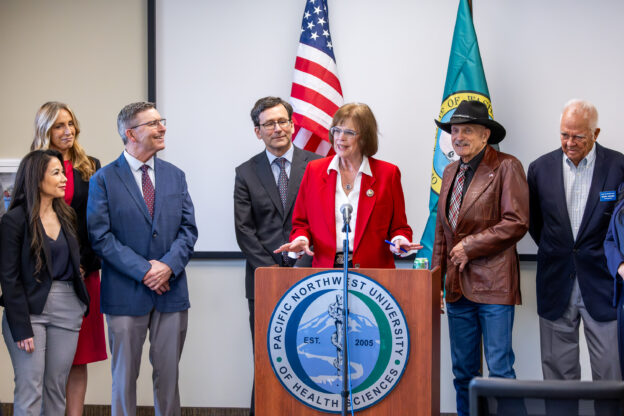
Sen. Judy Warnick’s legislation to help the Port of Moses Lake with major infrastructure improvements was signed by Gov. Bob Ferguson during a ceremony in Yakima on March 20. Her bill ensures the port remains eligible for federal funding to finish critical rail and power upgrades.

The law created by Senate Bill 6132 allows for a narrow 0.25% modification to indebtedness limits. Warnick introduced the legislation specifically to support local projects that keep the region’s economy moving forward.

“The title of this bill really says it all,” said Warnick, R-Moses Lake. “This is a small, simple measure meant to apply only to one specific situation. The Port of Moses Lake reached out and asked for our help to ensure they could cross the finish line on important local projects, and I am glad we could provide this solution. While this is a technical change, it has a very real impact on the port’s ability to build the infrastructure that keeps our community competitive and our economy moving forward.”

To maintain strict oversight, the additional bonding authority under SB 6132 is limited to port districts that have established a tax increment financing (TIF) area and have a comprehensive industrial development plan approved by the state Department of Commerce.

The bill’s journey into state law included a unanimous 49-0 vote in the Senate, reflecting the broad recognition of the Port of Moses Lake as a vital economic engine for the 13th District and the entire state. The signing of SB 6132 serves as a crowning achievement for Warnick, who has spent her 20-year legislative career advocating for the agricultural and industrial needs of Central Washington.

The new law will go into effect on June 11.

Warnick announces retirement from State Senate following two decades of public service

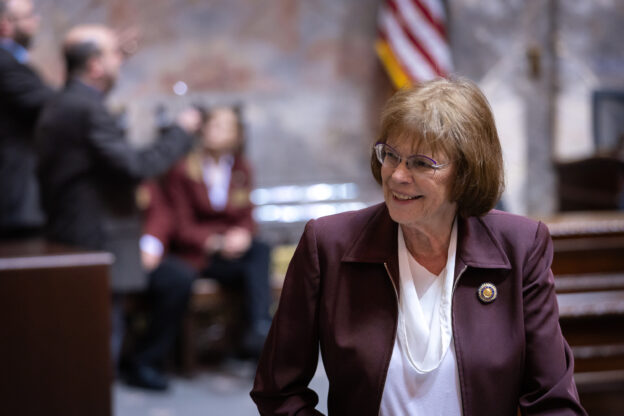
Sen. Judy Warnick announced today that she will not seek re-election to the Washington State Senate at the conclusion of her current term. A steadfast advocate for rural Washington and a respected leader in the Legislature, Warnick will continue to serve the 13th Legislative District until her term officially concludes in January 2027.

“Serving the people of the 13th Legislative District has been the greatest honor of my professional life,” said Warnick, R-Moses Lake. “I grew up on a dairy farm and ran my own small business, so I came to Olympia with a simple goal: to ensure that the hardworking families, farmers, and ranchers of Central Washington had a seat at the table. I am incredibly proud of what we have accomplished together to protect our water rights, support our small businesses, and empower the next generation of leaders.”

First elected to the House of Representatives in December of 2006 and later to the Senate in 2015, Warnick’s legislative career has been defined by her commitment to the agricultural community and the economic vitality of rural districts. Her peers recognized her leadership early on, electing her as vice chair of the Senate Republican Caucus in 2017, and as chair of the Senate Republican Caucus in 2021.

Beyond agriculture, Warnick has been a champion for youth and women’s sports, regional economic development, and community involvement. Honored as a “Woman of Achievement” and “Champion of Youth” by community organizations during her legislative career, she has been a leading voice for fairness and safety in girls’ sports, most recently leading a legislative listening session on the people’s initiative to the legislature on protecting the safety and privacy of young female athletes.

While she is looking toward the next chapter of her life, Warnick emphasized that her work in the Senate is far from over.

“I have always believed the most important job of a lawmaker is to listen. The people deserve to be heard, and that philosophy has been the basis for every vote I’ve cast in both the House and the Senate,” Warnick continued. “There is still much to be done, and I intend to work just as hard as I did on my first day until my very last day in office to ensure our communities remain a great place to live, work, and raise a family.”

Warnick’s collaborative approach and principled leadership have earned her the respect of colleagues on both sides of the aisle. As she prepares to serve out the remainder of her term, she remains focused on advancing policies related to public safety, water security, and rural economic opportunity.

As a member of the Ways and Means and Higher Education and Workforce Development committees, she has focused on fighting new and higher taxes and promoting policies to keep Washington’s economy competitive.

Her efforts have earned her numerous accolades, including “Legislator of the Year” honors from the Association of Washington Business, the Cattle Producers of Washington, and the Washington State Potato Commission, as well as the Guardian of Small Business award from the National Federation of Independent Business. She also received the Hall of Fame award from the Washington State Dairy Federation in March 2026.

Deadlines and Budget Battles

The 2026 legislative session is moving at a breakneck pace. Yesterday, February 25, marked a major milestone: the cutoff for policy bills to pass out of committee in the opposite house. We are now in the final stretch.

…This week, budget proposals were released, and I am deeply concerned by the direction they take. My colleagues across the aisle continue to push for reckless spending, growing the size of government, and imposing new taxes—including an unconstitutional income tax that voters have repeatedly rejected. I will dive deeper into these fiscal concerns below in this newsletter.

Click here to read my full newsletter.